The Character Who Carried the Story: How Fantasy's Supporting Cast Finally Gets Their Due
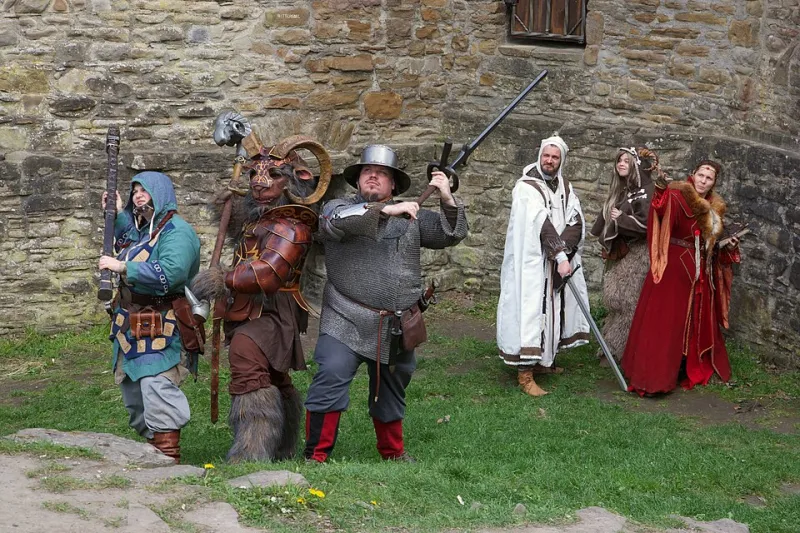
Photo: RalfHuels (photographer), Anja Arenz, Chris Kunz, Dossmo, Niamh, Paolo Tratzky, Svenja Schoenmackers, CC BY-SA 4.0, via Wikimedia Commons
Let's be honest about something. You've finished a fantasy novel, set it down, and immediately thought about someone who wasn't the main character. Maybe it was the sardonic best friend who made every scene warmer. Maybe it was the reluctant mentor whose choices haunted the margins of the plot. Maybe it was the quiet one in the back of the group who barely got three chapters but somehow felt more real than the person whose name was on the cover.
That's not a failure of the protagonist. That's a sign the author accidentally — or very intentionally — built someone extraordinary in the background.
Fantasy has always had a sidekick problem. Not in the sense that sidekicks are bad, but in the sense that the genre spent a long time treating them like furniture. They existed to reflect the hero's greatness, absorb exposition, and occasionally sacrifice themselves at dramatically convenient moments. They were defined entirely by their relationship to someone else. They didn't have histories that bled into their decisions. They didn't want things that conflicted with the plot.
That's changing. And the stories getting the loudest conversations right now are the ones where the supporting cast refuses to stay supporting.
The Hierarchy Was Always a Little Arbitrary
Think about the classic fellowship structure — the chosen hero at the center, everyone else orbiting around them. It made a certain kind of narrative sense. You needed a lens character. You needed someone for the reader to follow through an unfamiliar world. The hero was the entry point.
But entry point doesn't have to mean most interesting person in the room.
The problem with the traditional hierarchy is that it imposed a kind of emotional ranking on characters that didn't reflect how interesting they actually were. The hero got the internal monologue. The hero got the backstory flashbacks. The hero got the romantic tension and the moral crisis and the moment of transformation. Everyone else got a trait or two and a loyalty that was rarely questioned.
Modern fantasy writers — and a pretty vocal readership — have started pushing back on that. Not by eliminating protagonists, but by refusing to treat narrative depth as a resource that only the main character gets to spend.
What a Real Arc Actually Requires
Here's what separates a fully realized supporting character from a plot device wearing a personality: they have to want something that exists independently of the hero's quest.
Not just "I want to help my friend succeed." Something that creates genuine friction. A loyalty to a different cause. A past that makes the current mission complicated. A belief system that puts them sideways to the group's goals. When a supporting character has desires that occasionally conflict with the protagonist's, they stop being furniture and start being a person.
The best sidekick arcs — and we're using that word loosely, because "sidekick" barely covers what these characters actually are — involve someone who joined the adventure for reasons that made complete sense to them, and who then has to keep renegotiating that decision as the story gets harder. They're not just along for the ride. They're making a continuous choice to stay, and that choice costs them something.
That's the engine of a real arc. Not transformation for its own sake, but transformation that emerges from someone being tested against their own values.
The Readers Noticed Before the Genre Did
Fan communities have been ahead of this curve for a while. Spend any time in fantasy fandom spaces online and you'll notice that the characters getting the most detailed analysis, the most fan fiction, the most passionate defense are frequently not the protagonists. They're the ones whose inner lives had to be inferred, assembled from fragments, read between the lines.
There's something almost archaeological about the way readers engage with a well-written supporting character. The story gives you pieces. You construct the rest. And because you've done the work of building them in your head, they feel like yours in a way that a fully explained protagonist sometimes doesn't.
Smart authors have started writing into that instinct. They're leaving deliberate space for readers to inhabit — not because they're being lazy with characterization, but because partial knowledge creates intimacy. You lean in. You pay attention differently.
When the Background Becomes the Point
Some of the most talked-about fantasy of the last decade has done something structurally interesting: it's used the protagonist as the frame and the supporting cast as the actual subject. The hero's journey is the visible architecture, but the emotional weight lives somewhere else entirely.
This works because fantasy is, at its core, a genre about systems — systems of power, belief, magic, loyalty. And supporting characters are often the ones who reveal how those systems actually function at street level. The hero usually sits at the center of events, protected somewhat by their narrative importance. The people around them absorb the real consequences. They're the ones who show you what the world costs.
That's a kind of storytelling authority that the genre is only beginning to fully use.
What This Means for the Stories We Tell Next
The shift toward giving supporting characters genuine narrative weight isn't just a craft trend. It reflects something about what readers are actually hungry for — complexity, specificity, the sense that a world is populated by people rather than functions.
When a sidekick has a real arc, they're not undermining the hero. They're proving that the world the hero moves through is worth caring about. They're evidence that the stakes are real because real people are caught up in them.
The best fantasy doesn't just give you one person worth following. It gives you a whole cast of people who could each carry a story, and then asks you to watch what happens when all of them are trying to survive the same one.
The character in the background, it turns out, was never really in the background at all. You just weren't looking closely enough.