Lost Among the Stars: What Real Celestial Navigation Reveals About Fantasy Worldbuilding's Biggest Blind Spot
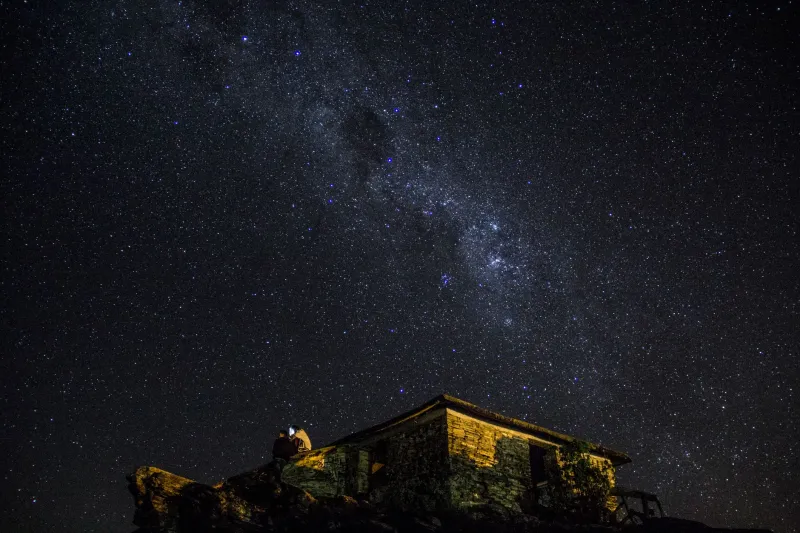
There's a scene in roughly half of all epic fantasy novels where a ranger, a ship captain, or a grizzled old scout glances up at the night sky, squints meaningfully, and announces exactly where they are and which direction they need to travel. It feels right. It feels ancient. It feels like something a person who really knows the wilderness would do.
It's also, in most cases, complete nonsense.
Not because celestial navigation isn't real — it absolutely is, and it's one of the most elegant intersections of mathematics, observation, and hard-won human knowledge ever developed. The problem is that fantasy writers tend to gesture vaguely at stars the way they gesture vaguely at blacksmithing or medieval surgery: they've absorbed the aesthetic without doing the homework. And for a genre that prides itself on immersive worldbuilding, that's a gap worth closing.
So let's talk about what navigating by stars actually looked like for the historical sailors and explorers who did it — and what your favorite fantasy series is quietly getting wrong.
The North Star Isn't a Magic GPS (But It's Pretty Close)
Polaris — the North Star — is the one piece of celestial navigation most people have absorbed from pop culture, and at least this part fantasy usually gets right. Polaris sits almost directly above Earth's geographic North Pole, which means it stays in roughly the same spot in the sky while every other star appears to rotate around it. Find Polaris, and you know which direction is north. Simple.
Except that's where the simplicity ends.
Knowing direction is not the same as knowing location. A medieval sailor who could identify Polaris knew they were heading north. They didn't automatically know whether they were off the coast of Newfoundland or halfway to Iceland. For that, they needed to measure Polaris's altitude — how many degrees above the horizon it appeared — which corresponds directly to their latitude. The higher Polaris sits in your sky, the farther north you are.
Historical navigators used instruments called quadrants and, later, astrolabes and cross-staffs to measure this angle with reasonable precision. It required clear skies, a steady hand, and a working knowledge of what the numbers actually meant. It was a skill, not a superpower — and fantasy fiction almost never treats it that way.
When a character in a fantasy novel looks up and immediately knows they're "three days south of the Thornwood," that's not celestial navigation. That's narrative convenience wearing a stargazer's cloak.
The Longitude Problem (That Killed Real Sailors for Centuries)
Here's where things get genuinely humbling: for most of human maritime history, nobody could reliably determine their longitude at sea. Not even close.
Latitude? Manageable, with the right tools. Longitude — your east-west position — requires knowing the time difference between your current location and a fixed reference point. And until accurate marine chronometers became available in the late 18th century, that was essentially impossible on a moving ship. The British government famously offered the equivalent of millions of modern dollars to anyone who could crack the problem. It took decades.
This matters enormously for fantasy worldbuilding. Any pre-industrial fantasy society — which describes roughly 90% of the genre — would face the same longitude problem that real historical sailors faced. A ship's navigator in a medieval-analogue fantasy world could tell you they were at a certain latitude. They could make educated guesses about longitude based on dead reckoning: tracking their speed, direction, and time elapsed since a known departure point. But they could not look at the stars and pinpoint their east-west position the way a modern GPS would.
Fantasy series that feature confident, pinpoint celestial navigation in pre-modern settings are quietly importing 18th-century technology into a world that hasn't earned it yet.
What the Stars Actually Told Historical Navigators
Beyond simple direction-finding, experienced navigators in the Mediterranean, Arab world, and Pacific used star paths in genuinely sophisticated ways that fantasy fiction rarely captures.
Arab astronomers developed detailed star catalogs and used instruments like the kamal — a simple wooden tablet on a knotted string — to measure stellar altitude with surprising accuracy. Polynesian wayfinders read star rise and set points on the horizon rather than star altitude, building mental maps of which stars rose over which islands. They also read ocean swells, wind patterns, and cloud formations in combination with the stars — a holistic reading of the environment that modern navigation software can barely replicate.
Viking navigators may have used a mysterious "sunstone" — likely a crystal of Iceland spar that can detect polarized light — to find the sun's position on cloudy days. Medieval European sailors relied heavily on the mansions of the moon and the positions of planets relative to known star patterns.
All of this is richer and stranger and more interesting than "he looked at the stars and knew where he was." Any one of these real techniques, dropped into a fantasy world with a little creative adaptation, would make for more compelling worldbuilding than the standard vague stargazing scene.
Where Popular Fantasy Gets It Twisted
Without naming names (mostly to avoid the kind of arguments that break out in comment sections and never fully resolve), here are the patterns that show up repeatedly in popular fantasy series:
The Instant Reckoning. A character emerges from underground — or from a forest, or from a dungeon — and within moments of looking at the sky, knows exactly where they are and which direction to travel. Real celestial navigation requires time, tools, and calculation. It is not a glance.
The Universal Sky. Fantasy worlds often feature entirely invented constellations but then have characters navigate by them exactly as if they were Earth's stars, with the same reliable north-pointing behavior. If your world orbits a different sun, has a tilted axis, or features multiple moons, the night sky behaves differently. Most fantasy worldbuilders don't follow that logic through.
The Forgotten Horizon. Celestial altitude measurements only work if you can see the horizon clearly. At sea, this is often possible. In a forest, a mountain pass, or a cloudy night — which is where most fantasy adventure takes place — it's much harder. Characters in fantasy novels rarely seem to notice.
Stars as Pure Metaphor. Sometimes fantasy uses the night sky as emotional backdrop and nothing else, which is fine — until a character is suddenly said to be navigating by those same stars, and the reader is expected to accept that the world has internal consistency it was never actually given.
A Practical Guide for Writers Who Want to Do This Right
If you're building a fantasy world and you want celestial navigation to feel earned rather than convenient, here are a few starting points:
Give your world a fixed celestial reference point — the equivalent of Polaris — and decide early on what it tells navigators and what it doesn't tell them. Latitude, not location.
Invent instruments. Astrolabes, cross-staffs, kamals — these are all simple enough to adapt into fantasy equivalents, and they immediately make navigation feel like a craft rather than a magical talent.
Embrace the longitude problem. Dead reckoning, estimated positions, navigational error — these create conflict and tension that "I looked at the stars and knew" never will.
Let your cultures develop different systems. A seafaring island culture might navigate by star rise-points. A desert people might use a network of known star-to-landmark alignments. A mountain culture might track planetary positions against fixed peaks. Variation makes the world feel inhabited by actual human ingenuity.
The night sky is one of the oldest tools humanity ever learned to use. It's also one of the most genuinely beautiful things you can put in a fantasy novel. It deserves better than being a prop. Give your characters the sky they actually need to earn — and let readers feel the weight of knowing that somewhere out there in the dark, the stars are the only thing standing between a lost sailor and oblivion.
That's a story worth telling.